

Magnifica Humanitas: Youth leader praises Pope Leo's 1st encyclical on AI as 'a tour de force'
- Jack Regan

- 2 hours ago
- 3 min read

Magnifica Humanitas is a real tour de force, calling the Church to use AI for effective evangelisation, says Jack Regan, the Director of Youth Services in the Diocese of Lancaster, as he reflects on Pope Leo XIV's first encyclical.
Like many workplaces, the youth service I run has spent a lot of time recently figuring out how to engage with AI. The things it’s brilliant for (graphic design, large data, writing reports), the things it really sucks at (reading colour-coded rotas, apparently) and the things we feel it shouldn’t be anywhere near (personal correspondence, prayer).
Whenever a new technology arrives, there are usually two extremes. Those who feel we should use the new thing uncritically, counterbalanced by those who pretty much feel it should be burned as a witch. In almost every case (the Industrial Revolution, computers, the internet, the smartphone) we eventually land somewhere in the sensible middle and find ourselves better for it.
The problem with AI, of course, (one of them) is that we haven't landed yet. We’re still in a holding pattern trying to figure it all out, and it’s in these holding pattern moments that the Church most needs its pastors. That’s why Pope Leo has decided to weigh in on the AI debate with his first encyclical Magnifica Humanitas.
Pope Leo XIV 'wants Magnifica Humanitas to be the Rerum Novarum of our day'
If you understand a little about Pope Leo XIII, then you have a large chunk of the origin story behind our current Pope. Leo XIII reigned from 1878 to 1903 and is largely associated with social justice. With the great encyclical Rerum Novarum, he effectively kicked off modern Catholic Social teaching (CST). Speaking shortly after his election, the current Pope Leo said that Leo XIII “addressed the social question in the context of the first great industrial revolution.” A revolution which at the time was still partly in a similar holding pattern, though people at the time probably didn’t use aviation metaphors.
Leo XIV has said often that he chose the name Leo in homage to Leo XIII. Now, he wants Magnifica to be the Rerum Novarum of our day.
Magnifica is a real tour de force. It reminds us that the Church is active in a lot of different spheres and it brings AI into all of them. It begins with a summary of the principles of CST and later touches employment, families, young people, education, and human trafficking among other things, interweaving AI throughout to remind the reader that nothing lives in isolation.
The central message about AI lands in that sensible middle we talked about above. Of course it does. AI “can be a valuable tool” (para. 100) but “it calls for a measured and vigilant approach” (Ibid). It needs responsible governance, transparency, and it needs to be kept a long way away from weapons, misinformation, and a few other obvious 'baddies'.
Calling 'generous missionaries' to use AI for effective evangelisation
Two biblical images are offered as a scaffold. We can build our future like a new Tower of Babel with an “idolatry of profit that sacrifices the weak” or we can go the way of Nehemiah rebuilding Jerusalem, “working together to make the City of God a safe place for returning exiles.” (para. 10)
What really impressed me is that the encyclical isn’t just a nuanced warning. The Church at its best looks for hope. In my day job, we want to use AI to help us to evangelise and Magnifica would seem to endorse that strongly, noting that “we all need to learn how to engage with the digital world in a human way, as an integral part of our education in the faith and in a life lived according to the Gospel. Indeed, we must consider the digital world as a new continent to be evangelised, one that requires generous missionaries who are mature in the faith.” (238)
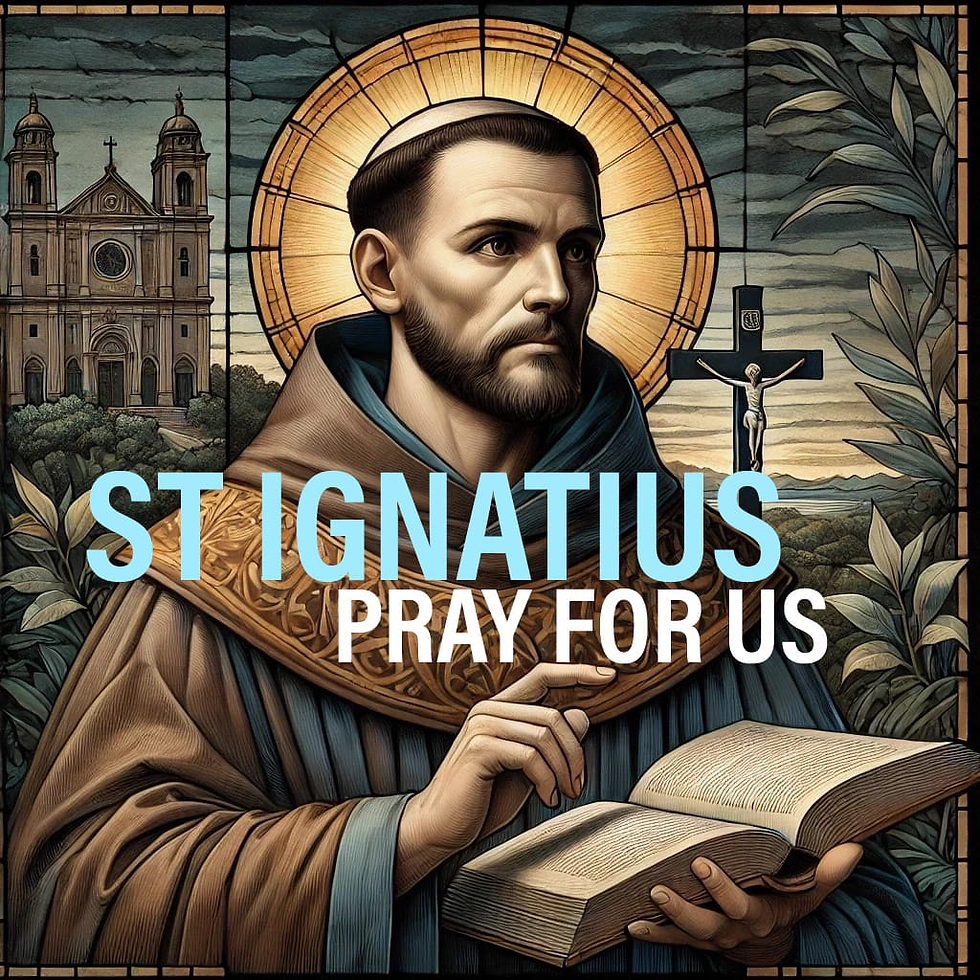
A few years back, we made AI-generated images of saints to mark feast days. Below is the one we came up with for St Ignatius.


Comments